A decision and its outcome.
- Situation
- A crew member can acknowledge reading a briefing while the condition that paused the work is still unresolved. If acknowledgment counted as clearance, paperwork would stand in for the control.
- Decision
- I kept acknowledgment and clearance separate. Reading the briefing records that it was read; the affected-area hold stays in place until it is cleared on its own terms.
- Reason
- The briefing needs to connect a hazard with a control. If reading the document could clear the hazard, the paperwork would replace the action it was supposed to support.
- What changed
- In the demonstration, Crew B’s acknowledgment is recorded and the hold remains, with the summary saying that completing the chain does not clear it. A separate offline-timeclock decision from the same project is in the note below.
Check it yourself.
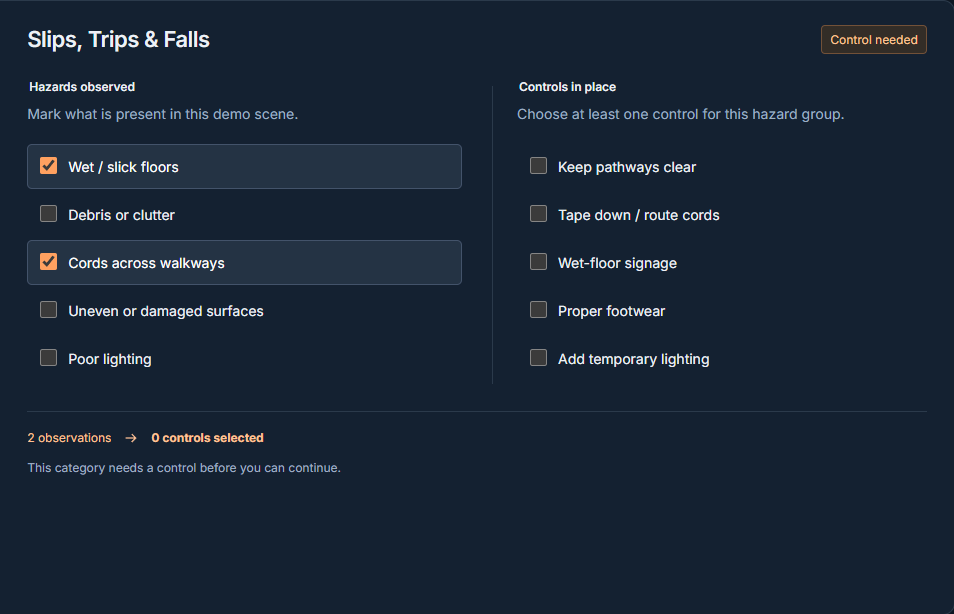
- A hazard with no control blocks the briefing.
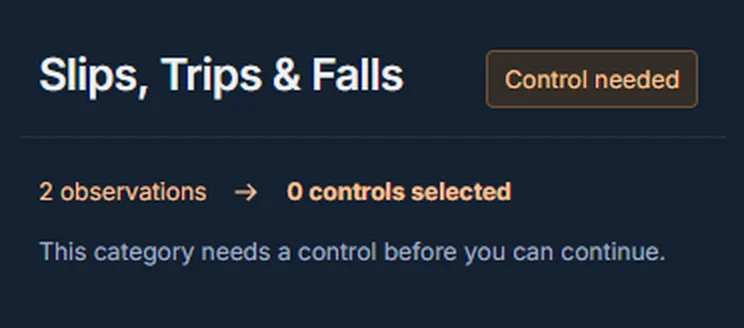
- Open Try Crewbrief, choose Wet floor, mark an observation and leave every control unchecked: the category reads Control needed and the next step stays unavailable until a control is chosen.
- Reading a briefing is not clearance.
- Choose Suspected material, preview the document, simulate the handoff to Crew B, read to the end and acknowledge: the summary records the acknowledgment and still shows the affected-area hold as paused.
- The example creates no real records.
- Refresh the page: the state resets. The scenarios, crew and hazards are fictional, and no record, notification or clearance is created anywhere.
How the briefing works
LaborHounds is a field-operations application I am developing. Crewbrief reuses its original rules for choosing controls and suggesting personal protective equipment (PPE), then follows the briefing through crew acknowledgment.
The PPE step suggests protective equipment but leaves the selections to the person preparing the briefing. The person chooses the equipment before previewing the document.
Trying a crew handoff
Start with Wet floor. The briefing begins incomplete. Choose a control, select PPE, then preview the document. Simulate the handoff to Crew B, read to the end, and acknowledge it.
Then try Suspected material. The affected-area hold stays in place after acknowledgment. The interaction records that the briefing was read; it does not claim the condition has been cleared.

A related decision: the offline timeclock
The same LaborHounds project had a separate offline timeclock. After review found a database conflict, I chose a device-generated primary key so queued actions could refer to the same entry without a new migration. AI implemented the repair; the related note follows its retries, reloads and rejected punches. The timeclock is outside this demonstration. The commit and its regression cases are in the private LaborHounds repository; they do not establish field adoption.