What happens before a rate is used
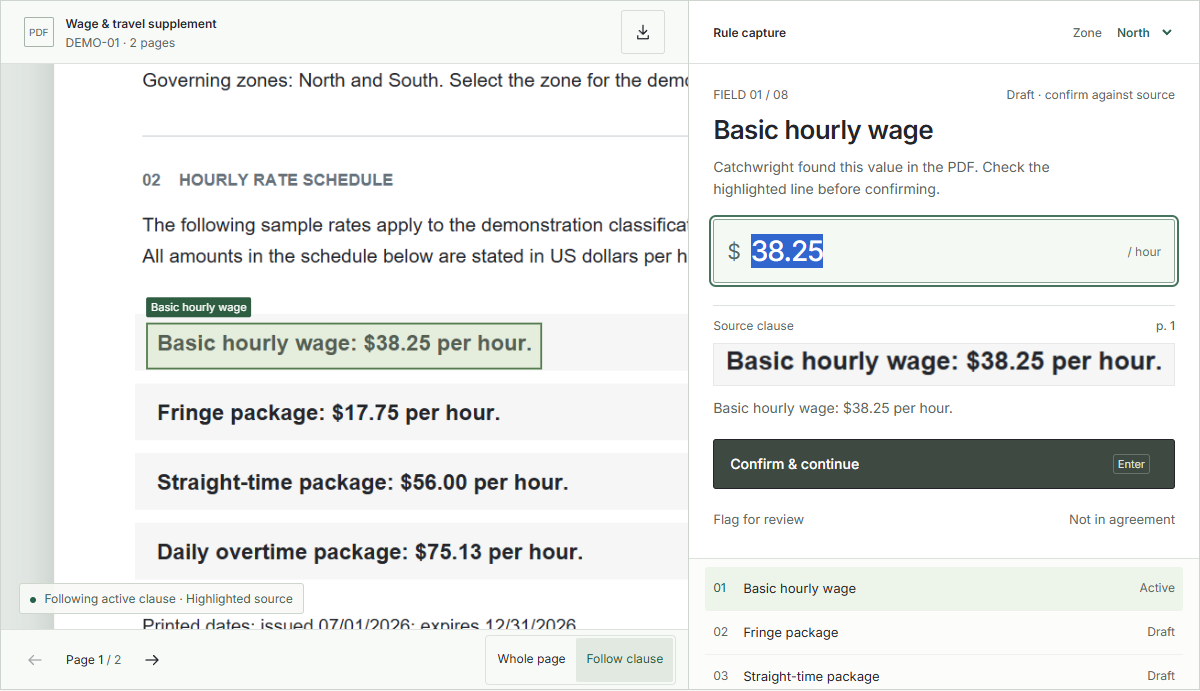
A number filled into a form can look ready to use before anyone has checked it. I designed the Catchwright demonstration to keep an extracted value as a proposal until a person checks it against the document.
The example uses a fictional two-page agreement. Its eight fields include four hourly-rate values, with the remaining fields covering travel and subsistence; selecting North or South changes which printed travel amounts the reviewer sees. The document follows the active field so the relevant clause stays beside the value. That arrangement gives the reader a practical way to challenge a proposal without searching the whole agreement again.
One threshold appears as “sixty (60)” in the source, and the demonstration deliberately leaves its value for the person to enter. Finding the clause and accepting a usable number are separate steps. A field can also be marked absent or held for review; neither choice creates an active numeric value.
After the fields are resolved, the person reviews the captured terms and attests that they checked the source. The hourly-rate comparison requires all four rate fields to be confirmed. A held rate leaves the source package incomplete. This is a useful failure state to try: the review can record an unresolved field without using its unconfirmed value in the comparison.
The comparison then shows the entered pay beside the confirmed rate. In the supplied example, $36 of basic pay plus $16 of fringe totals $52 per hour, leaving a visible difference of $4 per hour against the confirmed $56 package. The implementation converts the amounts to integer cents before comparison. Clearing an input withholds the affected comparison until a valid value is present.
The export retains each captured value’s source page, quoted clause and position on the page, so the relationship can survive beyond the form. Returning to edit a source field clears the completed attestation, and an edited value needs confirmation again. That confirmation belongs to the value that was checked.
I directed the original product and this September reconstruction, with AI-assisted implementation. Catchwright is retired. The example keeps its state in memory and supports only its supplied digital-text PDF. It has no OCR or arbitrary upload. Travel terms can be captured and exported; travel eligibility and individual payroll lines are outside the comparison. A displayed gap is an hourly-rate comparison, not wages owed or a compliance determination.
You can try the demonstration, including the states that keep a comparison incomplete.